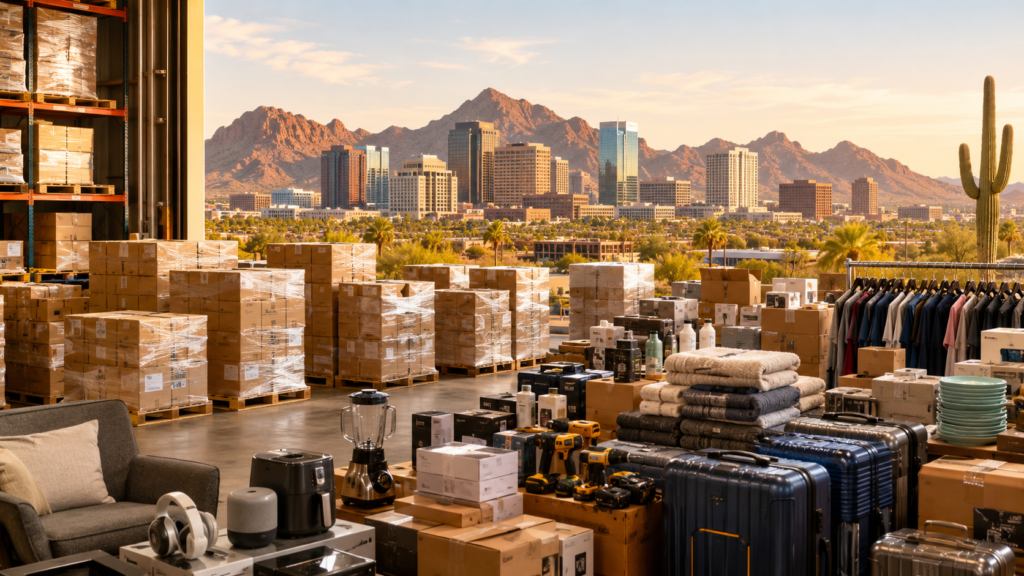
Arizona has become one of the most important retail and logistics markets in the Southwest. As Phoenix continues to grow, more retailers, ecommerce sellers, distributors, big-box stores, and seasonal businesses are handling larger volumes of physical inventory.
That growth creates opportunity, but it also creates surplus.
When products do not sell fast enough, retailers are left with overstock, customer returns, seasonal goods, discontinued SKUs, shelf pulls, and warehouse surplus. For businesses searching for inventory liquidation Arizona Phoenix overstock buyers, the goal is usually simple: recover cash, clear space, and move excess inventory before it loses more value.
Phoenix is especially important because it is a major population, retail, fulfillment, and distribution hub. The city’s retail market remains active, and recent market reporting shows Phoenix retail fundamentals have stayed strong, with limited availability, continued tenant demand, and strong absorption in 2026.
Source: Matthews Phoenix Retail Market Report
In a fast-moving retail market, inventory that sits too long can become a cash flow problem.
Why Arizona Has a Growing Surplus Inventory Market
Arizona’s population growth, business expansion, and retail development have helped create a larger inventory ecosystem. Phoenix is the state’s economic center, and the metro area supports big-box retail, shopping centers, ecommerce fulfillment, home goods sellers, seasonal retailers, apparel businesses, sporting goods sellers, consumer goods brands, and distributors.
The U.S. Census Bureau estimates Phoenix had more than 1.66 million residents in 2025, with continued population growth since 2020.
More people generally means more retail demand, more distribution, more store activity, and more product movement. But it also means more inventory risk.
Surplus inventory can build up when:
- Retailers over-order for demand
- Seasonal products do not sell through
- Ecommerce sellers forecast too aggressively
- Big-box stores reset shelves
- Product lines are discontinued
- Customer returns pile up
- Packaging changes
- New models replace old items
- Suppliers ship more than needed
- Warehouses need space for new products
Inventory liquidation gives Arizona businesses a way to recover value from stock that is no longer moving through normal sales channels.
Phoenix Retail Growth and Overstock Pressure
Phoenix’s retail growth has made it a strong market for both local and national brands. Grocery-anchored centers, neighborhood retail, restaurants, medical users, and suburban retail corridors continue to attract tenant demand. At the same time, strong retail activity means businesses must manage product turnover carefully.
When a market grows quickly, retailers may increase ordering to meet demand. But if sales forecasts are too high, products arrive late, or demand changes, overstock can build up fast.
Phoenix retailers may need overstock liquidation when:
- Inventory remains after a promotional cycle
- Seasonal goods miss the sales window
- Store resets require old products to move out
- Warehouse space is needed for new stock
- Customer returns are taking up backroom space
- Products are slow-moving across several locations
- Discounting is not enough to clear inventory
- New product launches replace older lines
The challenge is not just selling inventory. It is selling it quickly enough to protect cash flow and reduce warehouse pressure.
Big-Box Stores and Retail Closeouts in Arizona
Big-box retail creates a steady flow of excess inventory. Large retailers often manage high volumes of products across multiple categories, including home goods, apparel, electronics accessories, toys, seasonal décor, sporting goods, outdoor products, furniture, and general merchandise.
Retail closeouts may happen because of:
- Shelf resets
- Seasonal transitions
- Discontinued products
- Damaged packaging
- Overstocked SKUs
- Store closures
- Slow-moving product lines
- Regional demand shifts
- Customer returns
- Packaging updates
For Arizona stores, liquidation may be more practical than trying to sell every remaining item one by one. If products are palletized or available in bulk, a closeout buyer can evaluate the lot and help move the inventory faster.
Snowbird Retailers and Seasonal Inventory Cycles
Arizona has a strong seasonal retail pattern because many winter visitors, often called snowbirds, spend part of the year in the state. This affects certain retail categories, especially in areas with high seasonal population swings.
Snowbird-driven demand can affect:
- Home goods
- Outdoor furniture
- Patio products
- Sporting goods
- Golf accessories
- Health and wellness products
- Apparel
- Travel goods
- Home décor
- Household essentials
- Seasonal gift items
Retailers may stock more inventory ahead of peak visitor season. But once seasonal demand drops, excess inventory can remain.
This creates a timing problem. Holding off-season inventory can take up space and tie up cash. Liquidation helps businesses move excess seasonal goods before they lose value or become harder to sell.
Ecommerce Sellers and Phoenix Fulfillment Inventory
Phoenix and the broader Arizona market also support ecommerce sellers and fulfillment operations. Online sellers may hold inventory in warehouses, 3PL facilities, Amazon-related workflows, or local storage.
Ecommerce inventory becomes a liquidation candidate when:
- Products are not selling fast enough
- Ads become too expensive
- Marketplace competition increases
- Customer returns create mixed-condition lots
- Product launches underperform
- Seasonal demand ends
- The seller changes product categories
- Storage costs rise
- Inventory is removed from a fulfillment network
- Cash is needed for better-performing SKUs
For ecommerce sellers, the issue is often speed. Waiting for slow unit-by-unit sales can tie up cash for months. Bulk liquidation allows sellers to recover value and move on.
What Types of Arizona Inventory Can Be Liquidated?
Many types of inventory can be liquidated in Arizona, depending on category, condition, quantity, and demand.
Examples include:
- Retail overstock
- Customer returns
- Shelf pulls
- Store closeout inventory
- Ecommerce overstock
- Amazon seller inventory
- Home goods
- Apparel and footwear
- Outdoor furniture
- Sporting goods
- Toys and games
- Electronics accessories
- Seasonal décor
- Health and beauty products
- Patio and garden products
- Discontinued SKUs
- Packaging-change inventory
- Truckload returns
- Warehouse surplus
- Damaged-box goods
- Open-box products
If products are sitting in storage and no longer fit the active sales plan, they may be strong candidates for liquidation.
Why Holding Overstock Costs More Than Businesses Realize
Many Arizona businesses delay liquidation because they believe the inventory may eventually sell. Sometimes it does. But holding inventory has a cost.
Excess inventory can create hidden costs such as:
- Warehouse storage
- Staff handling
- Inventory counting
- Damaged packaging
- Lost shelf space
- Markdown planning
- Marketplace fees
- Transportation
- Insurance
- Cash tied up in slow-moving products
- Missed buying opportunities
- Reduced warehouse efficiency
For bulky items such as patio furniture, home goods, sporting goods, and seasonal products, storage costs can add up quickly.
At some point, the cost of holding inventory can be greater than the benefit of waiting.
When Arizona Businesses Should Consider Liquidation
Businesses should consider inventory liquidation when products are no longer selling profitably or when warehouse space is needed for more active inventory.
Liquidation may make sense when:
- Products have not sold within the expected timeline
- A retail season has ended
- Inventory is bulky or expensive to store
- Products are discontinued
- Customer returns are piling up
- Packaging has changed
- A store reset requires stock removal
- Ecommerce products are underperforming
- Discounting has failed
- Public markdowns would hurt brand value
- The business needs cash recovery
- Unit-by-unit resale is too slow
The best time to liquidate is usually before inventory becomes dead stock.
Liquidation vs. Discounting
Discounting can work when inventory quantity is small and demand still exists. But discounting is not always the best strategy for bulk inventory.
Discounting may require:
- Advertising
- Marketplace listings
- Customer service
- Returns handling
- Shipping
- Store promotions
- Long sell-through timelines
- Deeper markdowns over time
Bulk liquidation can be better when:
- Inventory is available by pallet or truckload
- Products are seasonal
- Warehouse space is limited
- The business wants cash faster
- Products are discontinued
- Mixed-condition inventory is involved
- Customer returns are too expensive to process
- Public discounts may damage brand perception
The right choice depends on volume, category, condition, and urgency.
How Phoenix Overstock Buyers Evaluate Inventory
Overstock buyers usually review several factors before making an offer.
These include:
- Product category
- Quantity
- Retail value
- Wholesale value
- Product condition
- Packaging condition
- Pallet count
- Box count
- Location
- Market demand
- Whether inventory is new, returned, open-box, or damaged-box
- Whether the lot is mixed or organized
- Whether there are resale restrictions
- Pickup or shipping requirements
The more complete the information, the faster the evaluation can move.
What Sellers Should Prepare Before Contacting a Buyer
Arizona sellers should prepare a clear inventory summary.
Useful details include:
- Product list
- SKU or UPC list
- Quantity by item
- Photos
- Condition notes
- Retail value
- Wholesale cost, if available
- Pallet count
- Box count
- Warehouse location
- Whether inventory is palletized
- Whether products are new, returned, open-box, or damaged-box
- Any expiration dates
- Any resale restrictions
- Desired timeline for pickup
Businesses can begin the process through the Liquidate Products or submit inventory directly through the Submit Your Inventory page.
How Liquidation Supports Southwest Inventory Planning
The Southwest market has strong seasonal and regional buying patterns. Arizona retailers may need to prepare for snowbird season, summer slowdowns, outdoor product demand, back-to-school, holiday inventory, tourism-driven purchasing, and regional consumer shifts.
Liquidation supports inventory planning by helping businesses:
- Clear old inventory before new stock arrives
- Recover cash from slow-moving goods
- Reduce storage costs
- Move seasonal products before value drops
- Remove discontinued SKUs
- Handle customer returns
- Improve warehouse space usage
- Support retail resets
- Avoid excessive public markdowns
For businesses managing physical goods, liquidation is not just a last resort. It can be part of a planned inventory strategy.
Internal Decision Framework: Keep, Discount, or Liquidate?
Use this simple framework to decide what to do with Arizona overstock.
Keep
Keep inventory that is still selling profitably, compact to store, and likely to remain relevant.
Discount
Discount inventory if demand still exists and quantities are small enough to clear through normal channels.
Reallocate
Move products to another store, warehouse, or sales channel if demand is stronger elsewhere.
Liquidate
Liquidate inventory if it is bulky, seasonal, discontinued, slow-moving, returned, damaged-box, or blocking space for new products. This framework helps businesses avoid holding inventory just because it still has theoretical retail value.
Why Work With an Inventory Liquidation Buyer?
A liquidation buyer can help businesses move inventory faster than unit-by-unit resale.
Working with a buyer may help:
- Reduce warehouse clutter
- Recover cash
- Move large quantities
- Avoid slow marketplace sales
- Clear seasonal goods
- Handle mixed lots
- Support warehouse cleanouts
- Remove discontinued products
- Protect brand value from public markdowns
You can also review related liquidation insights on the Liquidate Products to learn more about overstock, returns, closeouts, and inventory recovery.
Final Thoughts
Arizona’s retail and logistics market continues to create strong demand for inventory liquidation. Phoenix retailers, ecommerce sellers, big-box stores, snowbird retailers, and Southwest distributors all face the same challenge: products that do not move fast enough can quickly become expensive to hold.
For businesses searching for inventory liquidation Arizona Phoenix overstock buyers, the right solution is often bulk liquidation. It helps recover cash, clear space, and move inventory before value drops further.
Whether the inventory includes retail overstock, customer returns, seasonal products, ecommerce stock, home goods, sporting goods, patio products, or warehouse surplus, acting early can protect more value.
Ready to sell Arizona overstock or Phoenix surplus inventory? Visit Liquidate Products or submit your inventory through the Submit Your Inventory page to request a bulk liquidation quote.