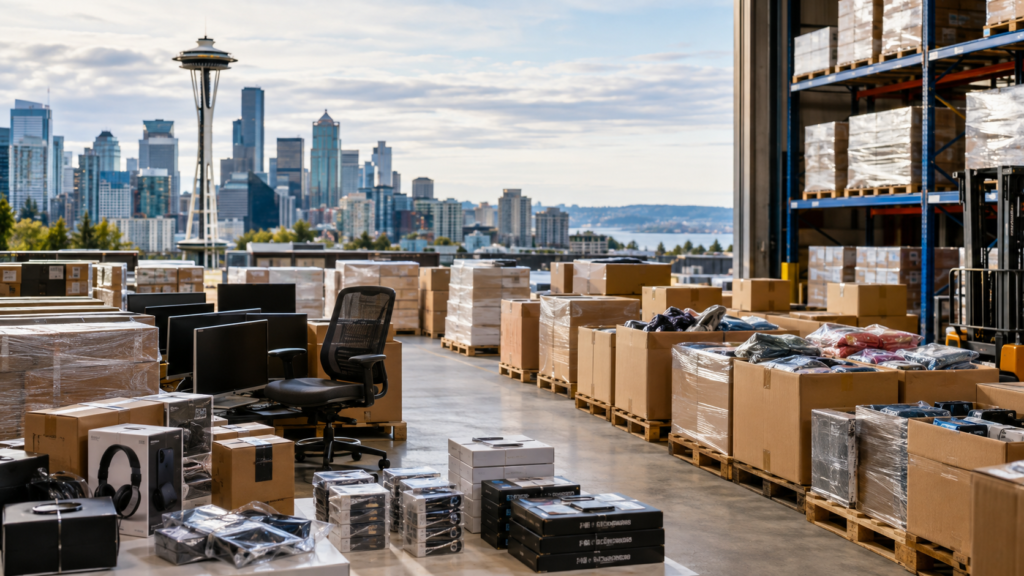
Washington State is one of the strongest technology, ecommerce, retail, and logistics markets in the United States. Seattle and the surrounding Puget Sound region are home to major technology companies, cloud businesses, online retail operations, startups, fulfillment networks, distributors, and consumer brands.
That growth creates a large and active surplus inventory market.
For businesses searching for closeout buyers Washington state Seattle tech surplus, the goal is usually simple: recover cash, clear space, and move excess inventory before it loses value.
Seattle’s economy is especially unique because technology and ecommerce are deeply connected. Seattle’s Office of Economic Development describes the city as a major technology and innovation hub, with strengths in software, ecommerce, gaming, AI, machine learning, and AR/VR.
When a market has this much technology, retail, fulfillment, and ecommerce activity, surplus inventory is unavoidable. Companies upgrade equipment. Startups downsize offices. Ecommerce sellers over-order. Retailers reset shelves. Warehouses accumulate returns. Distributors hold discontinued stock. Businesses need a practical way to liquidate what no longer fits their active operations.
Why Washington State Creates Unique Liquidation Needs
Washington’s business environment creates several types of surplus inventory.
A technology company may need to clear office furniture, electronics, monitors, peripherals, hardware accessories, packaging-change inventory, or equipment from a closed office. An ecommerce seller may need to liquidate slow-moving products, customer returns, open-box stock, or fulfillment overstock. A retailer may need to move seasonal goods, shelf pulls, home goods, apparel, or discontinued product lines.
Common Washington closeout inventory includes:
- Tech surplus
- Office equipment
- Consumer electronics accessories
- Ecommerce overstock
- Amazon seller inventory
- Customer returns
- Open-box goods
- Retail closeouts
- Shelf pulls
- Store closure inventory
- Seasonal merchandise
- Discontinued products
- Packaging-change inventory
- Warehouse surplus
- Furniture and fixtures
- General consumer goods
This mix makes Washington different from a purely retail-driven market. The surplus may come from offices, warehouses, distribution centers, ecommerce brands, software companies, hardware suppliers, and retail businesses.
Seattle Tech Surplus: What Can Be Liquidated?
Seattle’s tech ecosystem creates surplus beyond software. Physical assets still matter.
Technology companies, startups, corporate offices, IT departments, ecommerce teams, and operations groups often accumulate inventory and equipment that no longer fits current needs.
Seattle tech surplus may include:
- Office chairs and desks
- Monitors
- Docking stations
- Keyboards and mice
- Headsets
- Cables and adapters
- Consumer electronics accessories
- Packaging-change tech products
- Returned electronics accessories
- Startup office furniture
- Warehouse equipment
- Promotional products
- Branded merchandise
- Overstocked hardware accessories
- Open-box consumer tech items
Some items may be suitable for resale. Others may need careful handling, sorting, recycling, donation, or restricted-channel liquidation. The right approach depends on condition, quantity, resale restrictions, data/privacy concerns, and whether the products are consumer-facing or internal equipment.
For general public-sector surplus context, Washington State’s Department of Enterprise Services lists surplus categories such as electronics, office furniture, mobile devices, and other items no longer needed by agencies. That shows how common surplus asset movement is across public and private organizations.
Amazon, Microsoft, and the Broader Ecommerce Effect
Washington is closely associated with Amazon and Microsoft, and their presence has shaped the region’s technology and ecommerce ecosystem. Puget Sound Business Journal’s 2026 lists identify Amazon and Microsoft among the state’s largest public companies by revenue, with Amazon also appearing as the state’s largest employer.
This matters for liquidation because large technology and ecommerce ecosystems create secondary inventory pressure around them.
Not every surplus lot comes directly from a major corporation. Many lots come from the wider business network around these companies: vendors, sellers, service providers, startups, suppliers, wholesalers, office operators, ecommerce businesses, and local retailers.
Examples include:
- Amazon seller overstock
- FBA removals stored in Washington warehouses
- Startup office cleanouts
- Retail returns from ecommerce operations
- Consumer goods overstock
- Electronics accessory surplus
- Branded merchandise from old campaigns
- Office equipment after team moves
- Hardware accessories from product changes
- Warehouse closeouts
As ecommerce operations grow and shift, sellers need faster ways to move inventory that no longer performs.
Retail Surplus in Seattle and Washington State
Washington’s surplus market is not only about tech. Retail and consumer goods also play a major role.
Retailers in Seattle, Bellevue, Tacoma, Spokane, Vancouver, Everett, Redmond, Kent, and other commercial areas may accumulate products that no longer fit their active retail plan.
Retail surplus may include:
- Apparel
- Footwear
- Home goods
- Kitchen products
- Toys
- Electronics accessories
- Health and beauty products
- Seasonal goods
- Sporting goods
- Pet products
- Office supplies
- Furniture
- Customer returns
- Shelf pulls
- Store closure inventory
Retail surplus often builds up because of seasonal shifts, store resets, slow-moving SKUs, packaging changes, demand forecasting errors, or cancelled wholesale orders.
When retail inventory sits too long, it becomes more expensive to hold and harder to sell.
Ecommerce Overstock and FBA Inventory in Washington
Seattle’s ecommerce culture makes Washington a natural market for online sellers. Ecommerce businesses often deal with overstock because demand can shift quickly.
Ecommerce overstock may happen when:
- A product launch underperforms
- Ads become too expensive
- Marketplace competition increases
- Customers return products in volume
- A product becomes seasonal
- Storage costs rise
- Packaging or branding changes
- A seller changes niches
- A supplier ships more than expected
- Inventory is removed from fulfillment centers
For Amazon sellers, inventory can become a problem when FBA stock ages, storage fees reduce margins, returns become mixed-condition, or products are removed from Amazon and sent to a warehouse.
If that inventory sits in a Seattle-area warehouse, 3PL, office, or storage facility, the seller still needs a plan. Bulk liquidation can help recover cash instead of waiting for slow unit-by-unit sales.
Businesses can start by reviewing liquidation options on the Liquidate Products or by submitting inventory details through the Submit Your Inventory page.
Office Cleanouts and Business Surplus
Washington’s tech sector also creates office surplus.
Office cleanouts may happen because of:
- Company growth
- Company downsizing
- Remote-work changes
- Office relocations
- Startup closures
- Department moves
- Equipment upgrades
- Rebranding
- Lease changes
Surplus from office cleanouts may include:
- Desks
- Chairs
- Monitors
- Office accessories
- Shelving
- Conference room furniture
- Cables and adapters
- Promotional products
- Storage equipment
- Breakroom items
- Fixtures
Some office surplus may be better suited for reuse or donation. Other items may be suitable for bulk resale or liquidation. If electronics are involved, sellers should consider data security and proper handling before sale.
Why Holding Tech and Retail Surplus Costs More Than Expected
Many businesses hold surplus because they believe it may be useful later. Sometimes that is true. But holding inventory and equipment has a cost.
Hidden costs include:
- Storage space
- Warehouse labor
- Office clutter
- Moving costs
- Inventory tracking
- Depreciation
- Damaged packaging
- Obsolete equipment
- Lost resale value
- Missed cash recovery
- Reduced operational efficiency
Tech surplus can lose value quickly because newer models, updated accessories, and changing compatibility standards can reduce demand. Retail surplus can lose value because of seasonality, trend changes, packaging updates, and markdown pressure.
Waiting too long can turn recoverable inventory into low-value dead stock.
When Washington Businesses Should Consider Closeout Liquidation
Closeout liquidation may make sense when inventory or surplus assets no longer support the business.
Consider liquidation when:
- Products are no longer selling profitably
- Tech equipment has been replaced
- Office furniture is no longer needed
- Ecommerce inventory is slow-moving
- Amazon seller inventory has been removed
- Customer returns are piling up
- A product line is discontinued
- Packaging has changed
- Retail stock is out of season
- Warehouse space is limited
- Public discounting would hurt brand value
- Cash recovery is more useful than waiting
The best liquidation decisions happen before inventory loses too much value.
Liquidation vs. Public Discounting
Public discounting can help move some retail products, but it is not always the best option for bulk inventory.
Discounting may require:
- Listings
- Advertising
- Customer service
- Fulfillment
- Returns handling
- Long sell-through timelines
- Marketplace fees
- Public price reductions
Bulk liquidation can be better when:
- Inventory is available by pallet or truckload
- Products are discontinued
- Tech accessories are outdated
- Retail goods are seasonal
- Returns are mixed-condition
- Office surplus needs to move quickly
- The business wants to avoid public markdowns
- Cash recovery matters more than slow resale
A closeout buyer can evaluate the full lot and help move it faster than individual resale channels.
What Buyers Need From Seattle-Area Sellers
Before contacting closeout buyers, Washington businesses should prepare clear inventory details.
Useful information includes:
- Product category
- Quantity
- SKU or UPC list
- Photos
- Condition
- Retail value
- Wholesale cost, if available
- Pallet count
- Box count
- Location
- Whether inventory is new, returned, open-box, or damaged-box
- Whether office equipment is used or new
- Whether electronics have data/security concerns
- Whether products are palletized
- Any resale restrictions
- Desired pickup timeline
For tech surplus, include model numbers, condition, quantities, and whether data-bearing devices are included. For ecommerce and retail stock, include product lists, ASINs if applicable, packaging condition, and location.
Clear information speeds up the evaluation process.
Brand-Safe Liquidation for Tech and Retail Companies
Some Washington companies need discreet liquidation.
A brand may not want discounted products visible in public marketplaces. A tech company may not want branded merchandise resold without control. A retailer may not want customers seeing active products deeply discounted elsewhere.
Brand-safe liquidation can help businesses move inventory while managing resale concerns.
Before selling, clarify:
- Whether the brand can be used in resale listings
- Whether marketplace resale is restricted
- Whether the inventory should stay out of certain regions
- Whether packaging or labels require special handling
- Whether products are discontinued or active
- Whether confidentiality matters
A professional liquidation process should account for these concerns.
How Liquidate Products Helps With Washington Surplus
Liquidate Products works with businesses that need to sell overstock, closeouts, customer returns, discontinued products, shelf pulls, and surplus inventory in bulk.
For Washington State businesses, this can include tech surplus, ecommerce overstock, retail closeouts, office cleanouts, consumer goods, and warehouse surplus.
The process starts with inventory details. Sellers can submit product information, quantities, condition, photos, and location so the lot can be reviewed.
To learn more, visit the Liquidate Products or submit inventory through the inventory submission page.
Decision Framework: Keep, Reuse, Discount, or Liquidate?
Use this framework to decide what to do with surplus inventory.
Keep
Keep items that still support active operations or profitable sales.
Reuse
Reuse office equipment, fixtures, or tech accessories if they still have business value.
Discount
Discount small quantities of retail goods when public markdowns will not damage brand perception.
Liquidate
Liquidate large lots, discontinued inventory, outdated tech accessories, office surplus, ecommerce overstock, customer returns, and slow-moving products that no longer fit the business plan.
This keeps businesses from storing inventory simply because it still has theoretical value.
Final Thoughts
Washington State’s economy creates a strong market for tech surplus, ecommerce overstock, office cleanouts, and retail closeouts. Seattle’s technology leadership, Amazon and Microsoft’s regional influence, and the state’s active retail and ecommerce ecosystem all contribute to surplus inventory movement.
For businesses searching for closeout buyers Washington state Seattle tech surplus, the key is to act before inventory or equipment loses more value.
Whether the surplus includes electronics accessories, office furniture, ecommerce products, Amazon seller inventory, retail closeouts, customer returns, or discontinued goods, liquidation can help recover cash and clear space.
Ready to sell Washington tech surplus, Seattle retail closeouts, or ecommerce overstock? Visit Liquidate Products or submit your inventory through the Submit Your Inventory page to request a bulk liquidation quote.