You Bought for a Season That Didn’t Deliver. Now What?
You ordered for the snowbirds. They didn’t come — or came in far smaller numbers than the year before. You stocked generators and water filtration for hurricane season. The storm tracked north. You bought resort wear and outdoor goods for peak tourist season. Spending was softer than projected.
Now you’re sitting on inventory that’s costing you money every day it doesn’t move. Warehouse space in Florida isn’t cheap, and goods tied to a season that’s already passed don’t get more valuable with time.
This guide is for Florida retailers, importers, hospitality businesses, and distributors who need to find closeout buyers — fast — and want to understand which channels, timing windows, and buyer types actually work for Sunshine State inventory.
Why Florida Creates More Seasonal Overstock Than Almost Any Other State?
Florida doesn’t have one seasonal retail cycle. It has four — running simultaneously and rarely in perfect sync.
Florida’s retail market holds nearly 1.3 billion square feet of retail inventory — 11% of all US retail space — and accounted for 26% of all new US retail supply in the first half of 2025. More retail square footage means more inventory flowing through the system, and more of it ending up as surplus when the seasonal math doesn’t work out.
Florida is home to 84,353 stores, and Florida remains one of the nation’s largest retail markets. That volume is impressive — but it also means that when seasonal demand misses, the absolute dollar amount of overstock is larger than in almost any other state.
The four cycles that drive Florida’s overstock problem:
Florida’s Seasonal Overstock Calendar
Florida retailers don’t deal with one inventory cycle — they manage multiple overlapping demand windows throughout the year. Each creates its own liquidation risk when demand falls short of projections.
| Retail Cycle | Peak Season | Common Inventory Categories | Highest Overstock Risk | Best Liquidation Window |
|---|---|---|---|---|
| Snowbird Season | November – April | Resort wear, patio furniture, specialty food, outdoor goods | Lower-than-expected seasonal migration and tourism spending | March – May |
| Hurricane Preparedness | June – November | Generators, batteries, tarps, water filtration, emergency supplies | Quiet storm seasons or storms changing track | January – May |
| Tourism & Theme Park Peaks | Year-round with seasonal spikes | Licensed merchandise, hospitality goods, resort apparel, event products | Seasonal demand shifts and rotating merchandise cycles | Immediately after peak season or event |
| Population Growth & Housing Expansion | Ongoing | Home goods, furniture, hardware, appliances | Slower-than-expected residential absorption | Market dependent |
The timing matters. Seasonal inventory typically loses value fastest immediately after demand peaks, which is why businesses that move excess inventory early often recover more than those that wait.
The Snowbird Cycle (November – April)
This has been one of the most disrupted Florida retail cycles in recent years, with noticeable effects on seasonal inventory planning.
Canadian visits to Florida dropped 15% in the third quarter of 2025, continuing a trend that has persisted since early 2024 when US-Canada trade tensions began escalating. Canadian visits to the Fort Lauderdale area were down 32% year over year as of mid-2025.
Visit Lauderdale estimates the region has lost up to $90 million in economic activity since April 2025, with Canadian visitors down between 10% and 16% statewide. The Canadian dollar also hit a 22-year low against the US dollar in early 2025, making every purchase in Florida significantly more expensive for those who did come.
Retailers who stocked resort wear, outdoor furniture, specialty food, health and beauty, and lifestyle goods for the snowbird season are bearing the direct inventory cost of that shortfall. The overstock window for snowbird-cycle goods is narrow: March through May, before summer humidity and incoming summer inventory make these goods harder to move.
The Hurricane Preparedness Cycle (June – November)
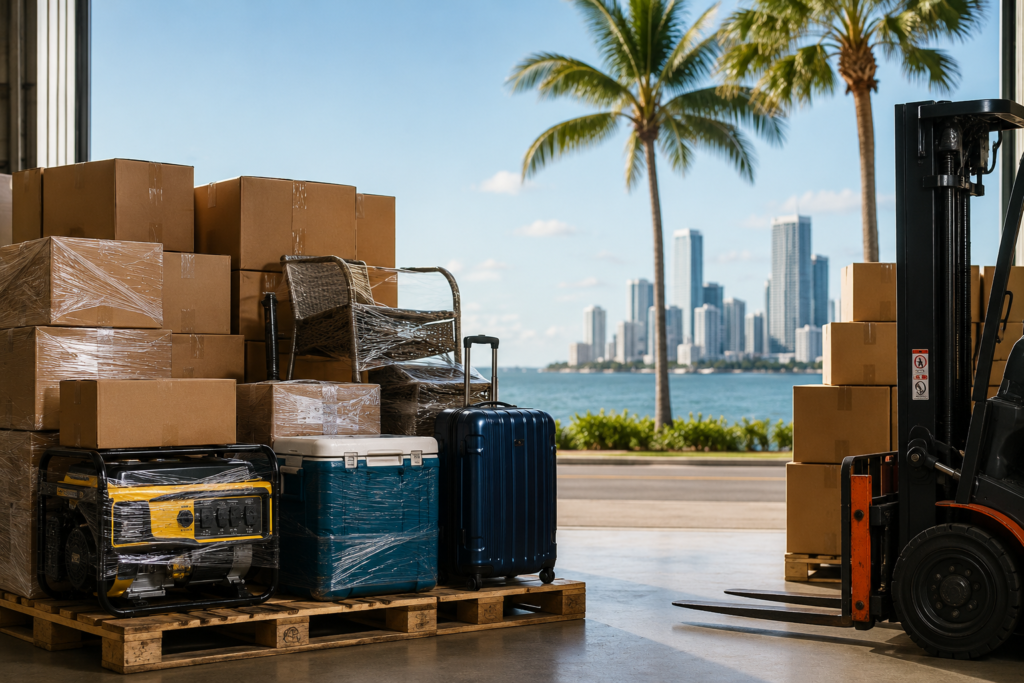
Florida retailers stock aggressively for hurricane preparedness — generators, portable power, water filtration, batteries, coolers, safety supplies, tarps. When a storm weakens, changes track, or misses populated coastal areas, that inventory often becomes difficult to move.
The challenge is category-specific: generators are bulky, expensive to store, and lose perceived urgency fast after a quiet season ends. The secondary market for preparedness goods compresses sharply in December. Sellers who engage closeout buyers in January through April — before the next season opens — often recover more than those who wait.
The Tourism Peak (Year-Round, With Seasonal Spikes)
Orlando attracted 75.3 million visitors in 2024, generating nearly $92.5 billion in economic impact — the most visited destination in the United States. Florida as a whole received 143.3 million visitors in 2025, with overseas visitors citing shopping as their top activity at a rate of 89%.
That volume drives enormous inventory purchasing and can also contribute to significant seasonal overstock when licensing agreements change, seasonal event merchandise rotates, or tourist spending runs below projections at the individual business level. Theme park-adjacent retail, hotel gift shops, and the entire hospitality goods supply chain are all exposed to this cycle.
The Population Growth Cycle (Ongoing)
The US Census estimated Florida’s population at 23.5 million in 2025 — an 8.9% increase from 2020. New residential communities opening across the I-4 corridor, Southwest Florida, and the Space Coast create demand spikes for home goods, furniture, and hardware that retailers anticipate but frequently overshoot when absorption slows.
The Florida Closeout Market by Metro: Where Surplus Concentrates
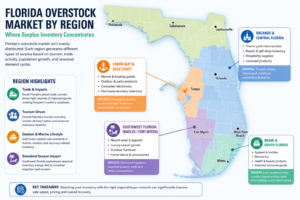
Miami and South Florida
Miami’s overstock profile is shaped by two forces that don’t exist anywhere else in the state: its Latin American trade corridor and its luxury consumer market.
The Miami Customs District — covering Miami-Dade, Broward, and Palm Beach — saw a 5% rise in trade in 2024, fueled by booming ties to Brazil, Colombia, and the Dominican Republic. PortMiami processed just over 1 million TEUs in 2024 with a cargo mix of roughly 46% Latin American and Caribbean, 33% Asian, and 20% European. Top imports include textiles, apparel, electronics, and construction materials.
The tariff front-loading surge of 2025 — importers rushing goods in before rate escalations — left Miami-area businesses with elevated inventory that’s still working through the market. For the full picture on why that import overstock problem is affecting Florida businesses specifically, our 2026 tariff excess inventory guide breaks down the mechanics in detail.
Port Everglades’ top imports by value include medical instruments, apparel (T-shirts and sweaters), and motorboats and yachts — categories that reflect both Florida’s consumption patterns and its role as a gateway for Latin American trade. When apparel overstock accumulates in South Florida, buyers with Latin American export channels often recover more than domestic-only secondary market buyers. Ask explicitly about export capability before committing to any Miami-area liquidator.
Orlando
Central Florida’s retail market closed 2025 and entered 2026 with quiet but durable strength — stability rooted in limited new construction, tight vacancy, and a reliably backfilled footprint. Tight occupancy means retailers pay real carrying costs for slow-moving goods.
The overstock most specific to Orlando is tourism-adjacent merchandise: licensed character goods, seasonal park event products, resort wear, and hospitality supplies tied to the theme park ecosystem. These have hard value windows — merchandise tied to a seasonal event or entertainment license drops sharply once the window closes. Fast action is essential.
The I-4 corridor warehouse district, stretching through Orange and Osceola Counties, is where Orlando’s secondary market activity concentrates. Buyers with established Central Florida logistics relationships will move faster and offer better pricing than those without.
Tampa Bay
Tampa ranked second among top US retail markets in 2025, with the strongest rental growth metrics in Florida driven by rapid population growth and broad commercial expansion.
Tampa’s overstock profile spans hospitality goods from the Gulf Coast corridor, consumer electronics from its growing e-commerce distribution sector, and outdoor and marine goods serving one of Florida’s most active boating markets. The Gulf Coast hurricane impact of 2024 (Helene and Milton) created post-recovery surplus in Southwest Florida that continues to work through the secondary market — goods ordered for recovery demand that exceeded actual rebuilding speed.
Southwest Florida: Naples, Fort Myers, and the Snowbird Epicenter
This corridor has been particularly affected by the snowbird inventory slowdown. Fort Myers and Cape Coral alone attracted more than 215,000 Canadian visitors annually in recent prior years, spending more than $218 million — making the Canadian visitor decline uniquely painful for this market.
The merchandise profile here is distinct: high-end casual apparel, resort wear, marine goods, specialty food and beverage, and luxury lifestyle accessories ordered for a demographic that simply didn’t arrive in expected numbers. Buyers for this inventory need access to quality retail resale channels, not just discount disposal.
The Three Categories That Need Florida Closeout Buyers Most Right Now
Hospitality and Resort Goods
Hotel renovations, brand flag changes, and vacation rental turnovers generate a continuous stream of furniture, fixtures, linens, kitchen equipment, and guest amenity products. Florida’s hospitality sector — driven by 507,000 hotel rooms across nearly 4,800 properties statewide — produces more FF&E surplus than almost any state.
When a hotel rebrands or renovates, existing fixtures need to move fast. Project timelines don’t allow for months-long liquidation processes. This is a category where direct buyers — who can commit, coordinate logistics, and close quickly are often the fastest and most practical option.
Outdoor, Marine, and Hurricane Preparedness Goods
Florida has the country’s largest recreational boating market, and outdoor and marine goods are among its most actively purchased categories year-round. When purchasing overshoots demand — post-hurricane quiet season, snowbird shortfall reducing outdoor furniture sales at Gulf Coast shops — the surplus is large and category-specific.
Generators deserve specific attention. They are among the most commonly overstocked preparedness products in Florida’s preparedness cycle. They are heavy, expensive to warehouse, and depreciate in perceived urgency after a quiet season. If you’re holding generators or other hurricane preparedness goods now, the pre-season window (January through May) is your best recovery opportunity. After June, the secondary market for this category compresses.
Consumer Electronics
Florida’s combination of large tourist volumes, a spending-capable retiree population, and fast-growing permanent residents makes it a major consumer electronics market in the Southeast. Shopping was cited as the top activity by 89% of overseas visitors to Florida — and electronics consistently rank among their top categories, particularly buyers from Latin America for whom Florida pricing offers genuine advantages over home market costs.
When electronics overstock accumulates — from tourist-facing retail, FBA seller returns, or import surplus through Miami — South Florida’s export buyers often recover more than domestic-only secondary channels. Electronics moving to Latin American markets through Miami’s trade network can command better pricing than the same goods sold purely into US discount retail.
What Makes Florida Liquidation Different: Three Operational Realities
Timing is more critical here than in any other state. Snowbird-cycle goods sold in March are worth considerably more than the same goods sold in July. Hurricane prep goods sold in February beat the same goods sold in December. The seasonal timing of your liquidation decision directly affects recovery rate in Florida more than almost anywhere else in the country.
Geography matters more than it appears. Florida is over 500 miles long. A buyer based in Miami doesn’t efficiently serve a Naples or Tampa business. Confirm geographic coverage explicitly before engaging any closeout buyer — and for businesses spread across multiple Florida markets, prioritize national buyers with established statewide logistics relationships.
The Latin American export channel is unique to South Florida. Miami maintains a rare trade surplus with its top partners, with $42 billion in exports versus $30 billion in imports, with strong ties to Brazil, Colombia, and the Dominican Republic. For consumer goods, apparel, electronics, and health and beauty, buyers with active Latin American distribution will offer better pricing than domestic-only buyers. This channel simply doesn’t exist at the same scale anywhere outside Miami.
How to Move Your Florida Inventory Quickly
Step 1 — Identify your time-sensitive inventory first. Seasonal goods have a selling window that closes. Hurricane prep merchandise, snowbird-cycle apparel, and resort goods should be your first priority. Get these to market while buyers are still active for the category.
Step 2 — Prepare a complete inventory manifest. A detailed manifest — with product names, brands, SKUs, quantities, conditions, and MSRP — is what gets you a fast, accurate quote. Without it, buyers slow down or move on. Use our free Excel manifest template to build one in the right format.
Step 3 — Ask the right questions of any buyer. Does the buyer cover your specific Florida location? Do they have Latin American export channels if you’re in South Florida? What’s their timeline from offer to pickup? Can they handle bulky goods (generators, outdoor furniture, marine equipment)?
One of the biggest mistakes businesses make with seasonal inventory is waiting too long to move it. In Florida’s seasonal retail environment, recovery value often declines once the peak demand window closes.
How Seasonal Inventory Value Changes Over Time
| Timing After Peak Season | Typical Buyer Demand | Estimated Recovery Potential |
|---|---|---|
| During peak season | Very high | Strongest recovery opportunity |
| 1–2 months after season | High | Moderate-to-strong recovery |
| 3–4 months after season | Moderate | Reduced recovery potential |
| 5–6 months after season | Low | Limited buyer interest |
| After next seasonal cycle begins | Very low | Often heavily discounted |
The exact recovery value depends on product category, condition, brand, and market demand — but in most seasonal categories, buyer interest tends to decline as inventory moves further away from its original selling window.
Step 4 — Submit and move fast. The recovery rate for seasonal Florida inventory starts declining the moment the season ends. First movers consistently recover more than those who hold and hope.
Submit your Florida inventory for a free evaluation at LiquidateProducts— we respond within 24 hours with a direct offer.
How LiquidateProducts Serves Florida Businesses
LiquidateProducts purchases overstock, seasonal surplus, and closeout inventory directly from Florida businesses across all major metros — Miami, Fort Lauderdale, Orlando, Tampa, Jacksonville, Sarasota, Fort Myers, and surrounding areas.
We buy hospitality goods, outdoor and marine equipment, consumer electronics, apparel, home goods, hurricane preparedness products, and general merchandise. We understand the seasonal dynamics that make Florida’s overstock problem unique and move fast enough to reach market while your selling window is still open.
If you’re an Amazon FBA seller dealing with aged inventory fees on Florida-warehoused goods, our Amazon FBA liquidation guide covers how to direct removal orders to our facility and stop fees from accruing immediately.
Get a free inventory evaluation here.
Frequently Asked Questions
When is the best time to liquidate snowbird-cycle inventory in Florida? March through early May. By June, buyer interest in resort wear, outdoor furniture, and snowbird-season lifestyle goods compresses significantly. Act before the window closes.
Who buys hurricane preparedness goods in Florida? National emergency preparedness resellers, export buyers serving Caribbean and Gulf markets, and discount retailers in other hurricane-prone states. January through May is the optimal selling window — before the season reopens and before last season’s goods are viewed as dated product.
Do Miami buyers have Latin American export channels? Some do, some don’t — and for electronics, apparel, and health and beauty, the difference in recovery rate can be meaningful. Ask explicitly which categories they move internationally and to which countries before committing.
How does the retail closure wave affect Florida’s secondary market? Florida is among the hardest-hit states in the national closure cycle, with significant Macy’s, GameStop, and other chain closures adding to the secondary market supply. Our 2026 retail store closures post covers this in detail. For sellers, it means more competition for buyer attention in overlapping categories — another reason to act early.
Can I liquidate FBA inventory sitting in a Florida fulfillment center? Yes. Create a removal order in Seller Central directing Amazon to ship to our receiving address. Our Amazon FBA liquidation guide walks through the process step by step.
Conclusion
Florida’s seasonal overstock problem is predictable, recurring, and expensive to ignore. The snowbird shortfall, the quiet hurricane season, the tourism merchandise that didn’t sell through — these aren’t surprises. They’re structural features of doing business in a market built on seasonal cycles.
The businesses that manage them best are the ones who have buyer relationships in place before surplus accumulates — and who move while their inventory still has seasonal value, not after the window has passed.
LiquidateProducts is ready to evaluate your Florida inventory and make you a direct offer within 24 hours. Submit your inventory here to get started.